



How to Size a Dog Bed for Large, Small, and Stretch-Out Sleepers


The right dog bed is large enough for your dog to settle in a favorite sleeping position, with room to shift without slipping off the edge. To choose one, measure your dog while resting, then compare those measurements with the bed’s usable sleeping surface, not just the size label or overall footprint.
That distinction matters whether you’re shopping for a small dog bed, a large dog bed, or a memory foam dog bed. Two beds marked “large” may have different dimensions, and a thick bolster can leave less flat space than the outside measurements suggest.
Start with your dog’s habits. A compact sleeper may enjoy a cozy shape, while a dog that sleeps on its side with legs extended needs a wider, longer surface. The American Kennel Club recommends considering a dog’s size and sleeping preferences when choosing a bed (American Kennel Club, n.d.).
Start With Your Dog’s Resting Measurements
A weight recommendation can help narrow your search, but it cannot show how much room your dog takes up while asleep. Dogs of similar weight may have very different body lengths, and even the same dog can need different amounts of space depending on posture.
How to measure your dog for a bed
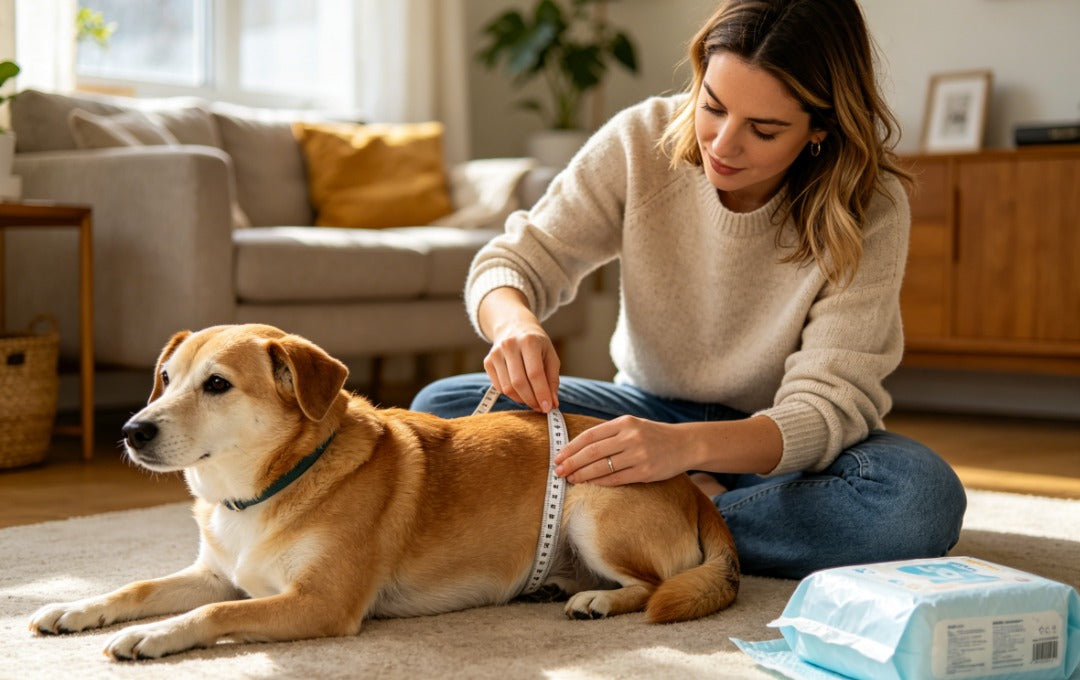
Use a soft measuring tape and wait until your dog is relaxed in a natural resting position. There’s no need to move or straighten your dog.
- Measure the resting length. Measure from the furthest point at the head to the furthest point at the rear, including any paws or tail that normally extend beyond the body.
- Measure the resting width. Measure across the widest part of the occupied space, including extended legs.
- Repeat in another favorite position. If your dog curls up at night but stretches out for daytime naps, record both.
- Note the larger measurements. Use these to compare beds if you want one bed to accommodate both positions.
- Allow some extra room. Look for a sleeping surface larger than the measurements so your dog has space to settle and change position. The amount depends on the dog and bed shape; there is no single allowance that guarantees a fit.
Keep the tape loose and measure the space your dog occupies, rather than wrapping it around the body. A photo of the sleeping position can also help when you compare shapes later.

For a dog that changes position often, observe a few naps at different times of day. A tightly curled pose may underestimate the space needed for a side-sleeping stretch.
A practical dog bed size chart
Use this chart to match sleeping habits to a surface. It is a starting point, not a substitute for measuring your own dog.
| Dog or sleeping style | What to measure | What to look for |
|---|---|---|
| Small, compact sleeper | Curled length and width | A surface that fits the curled body with room to reposition |
| Long-bodied small dog | Nose-to-rear length and stretched width | Enough length even if the weight label suggests a smaller size |
| Medium or large side sleeper | Full resting length and width, including legs | A broad, flat area that accommodates the extended body |
| Fully stretched sleeper | Furthest points from head or front paws to rear paws | A longer surface with room beyond the usual stretch |
| Dog that alternates positions | Both curled and stretched dimensions | A bed sized for the larger position, with a shape the dog enjoys |
For example, if a relaxed dog occupies approximately 36 inches by 24 inches when stretched out, a sleeping surface measuring exactly 36 by 24 inches leaves little room to shift. Look for a larger usable area and consider whether the dog likes to rest against a raised edge.
Read Dog Bed Dimensions From the Inside Out
A listing may show the bed’s length and width without making it clear whether those numbers describe the outside edges or the space your dog can actually lie on.
Exterior dimensions describe the bed’s overall footprint. They help you decide whether it fits beside the sofa, inside a crate, or in a bedroom.
Usable sleeping dimensions describe the area available for resting. On a flat mattress-style bed, that area may be close to the exterior dimensions. On a bed with raised sides, the interior can be noticeably smaller.
Both measurements matter. A bed can fit neatly in your room and still be too cramped for your dog.
Account for bolsters and raised sides
Bolsters are raised padded edges that can give a dog somewhere to rest its head or lean. They also occupy space. Depending on their shape and firmness, some of the sloping edge may not function like a flat sleeping surface.
Imagine a rectangular bed advertised as 40 by 30 inches overall. If the product diagram shows that the flat interior measures 32 by 22 inches, compare your dog’s resting measurements with 32 by 22 inches, not 40 by 30. These figures are an illustration, not the dimensions of a particular product.

For a round or oval bed, check the interior dimensions in both directions. A single outside diameter may not tell you how much space remains inside a thick rim.
Manufacturers may describe dimensions differently across designs. For example, Furhaven’s sofa-style product listing is a useful place to inspect how a raised-edge design is presented, while Big Barker’s product listing provides another manufacturer reference. Check the current diagram and selected size rather than assuming that a measurement means the same thing on both pages (Furhaven, n.d.; Big Barker, n.d.).
What to check on a product listing
Before placing an order, find or ask for:
- The selected model and size, since dimensions can change between options.
- Exterior length, width, and height.
- Interior or flat sleeping-surface length and width.
- The location and height of bolsters, including any opening for entry.
- Whether measurements include the cover, raised edges, or other features.
- Whether the seller describes measurements as approximate.
If the listing gives only an exterior measurement, don’t assume it is the usable area. Ask the seller for the interior dimensions, especially when comparing a bolstered bed with a flat one. If that information isn’t available, allow for the uncertainty when deciding whether to order.
Match the Bed to Sleeping Style and Daily Life
The best shape is the one your dog can use comfortably in the space you have. Watch how your dog settles on the floor, a blanket, or an existing bed before choosing a design.
Curled, side, and stretch-out sleepers
A curled sleeper may appreciate a round, oval, or bolstered bed that provides an edge to lean against. Check that the interior still leaves room to turn and that the dog can stretch out elsewhere if the bed is deliberately compact.
A side sleeper often needs more width than a curled measurement suggests. A rectangular bed with a generous flat area can accommodate legs extending away from the body. If it has bolsters, make sure they do not crowd the usual sleeping position.
A fully stretched sleeper needs enough length for the head, body, and extended paws. A flat or open-sided design may make positioning easier, but a larger bolstered bed can also work if its interior is spacious enough.

Some dogs use the edge as a pillow while leaving their bodies on the mattress. Others avoid raised sides entirely. Neither preference is a sign that one shape is medically necessary.
Room space and getting in
Measure the available floor space as well as your dog. Use the bed’s exterior dimensions for this step, and leave enough clear space around the entrance for your dog to approach and turn.
Consider:
- Whether a door, drawer, or walkway will be obstructed.
- Whether a bed placed against a wall will leave its opening accessible.
- Whether the bed will fit in a crate or designated sleeping area without buckling.
- Whether your dog can step onto the surface without negotiating an edge that seems difficult.
A low or open entry may be worth considering for an older dog or one with limited mobility. Watch your dog’s movements and discuss persistent stiffness, pain, or difficulty getting up with a veterinarian. A bed can be part of a comfortable resting setup, but it is not a treatment for arthritis or another condition (VCA Animal Hospitals, n.d.).
Foam, covers, and cleaning
Once you have a promising size, check the construction of the exact model. “Orthopedic-style” describes a product category or design claim; it does not, by itself, tell you that a bed contains memory foam. A memory foam dog bed may use memory foam as one layer within a larger construction, so read the material description rather than relying on the title alone.
Also check:
- Whether the cover is removable and how it should be washed.
- Whether the foam or inner liner has separate cleaning instructions.
- Whether any water-resistant layer is included, and which parts it protects.
- Whether the bed’s height and surface feel are suitable for your dog.
- Whether the seller states the foam layers and thickness.
Easy cover care can be useful for puppies, seniors, muddy-pawed dogs, and dogs prone to accidents. Water resistance is not necessarily waterproofing, and a washable cover does not mean the foam itself can go in the washing machine. Follow the selected product’s instructions.
Current model-specific dimensions, materials, and care details for Bella & Pal were not independently verified for this guide. Check the selected product page or ask the seller about any missing details before comparing it with another bed.
Confirm the Fit Before and After Ordering
A few checks before checkout can prevent a size problem from becoming a return problem. Keep your dog’s measurements nearby and record the product’s usable and exterior dimensions for the exact size selected.
Before you buy
Review the seller’s current purchase and return terms, including:
- The return window and when it begins.
- Whether a used, opened, or expanded bed is eligible for return.
- Return shipping costs and any other fees.
- Packaging requirements and how to initiate a return.
- Whether the terms differ when buying through another retailer.
Policies can change, and Bella & Pal’s current return terms were not independently verified for this guide. Confirm them with the seller before ordering. If interior dimensions or a policy condition are unclear, ask for clarification and keep the response with your order information.
A simple floor mock-up can help. Mark the exterior footprint with painter’s tape, then mark the stated sleeping area inside it. This makes it easier to see both whether the bed fits the room and whether the interior looks generous enough for your dog. It is a planning aid, not a substitute for testing the actual bed.
After the bed arrives
Follow the product’s setup instructions, including any directions for allowing compressed foam to expand. Then invite your dog to explore the bed without forcing them onto it.
Over several rest periods, look for a comfortable fit:
- Your dog can lie in a usual position without the body or extended legs regularly falling off the usable surface.
- There is room to turn, settle, and change position.
- The entrance is easy to reach and use.
- Raised sides do not force the dog into an unusually cramped posture.
- The bed stays in an appropriate position on the floor.
An occasional paw over the edge does not automatically mean a bed is too small. Look at the whole pattern: whether your dog has the option to lie comfortably on the surface and chooses to use it.
Recheck the fit as a puppy grows, after a change in mobility, or when you move the bed to a different part of the home. A size that worked for one stage of life may not remain the most practical choice.
Frequently Asked Questions
How do I choose the right dog bed size?
Measure your dog’s length and width while resting, including extended paws, and repeat in other favorite positions. Compare the largest relevant measurements with the bed’s usable sleeping area, allowing extra room to shift. Then check that the exterior fits your space.
Should I size up for a dog that stretches out?
Often, a larger usable surface is worth considering if it lets your dog stretch without hanging off the bed. Check the actual interior dimensions before sizing up: a larger outside footprint does not always mean a proportionately larger flat area, particularly with thick bolsters.
Is a weight-based dog bed size chart enough?
No. Weight ranges can help you find a starting size, but they do not account for every dog’s length, width, or sleeping style. Use the chart alongside your dog’s resting measurements and the product’s sleeping-surface dimensions.
Can a bed be too big for a small dog?
A large bed may fit physically, but some small dogs prefer a cozier edge to lean against. Think about where your dog currently chooses to rest. If you choose a smaller bolstered bed for curling up, make sure your dog also has room to change position and access to a place to stretch out.
Is a memory foam dog bed the best choice for an older dog?
That depends on the individual dog and the bed’s construction. Check the size, entry height, materials, and care requirements, then observe how your dog uses it. For pain, stiffness, or changes in mobility, ask a veterinarian for guidance rather than relying on a bed as treatment.
How do I know whether a bolstered bed is large enough?
Compare your dog’s resting measurements with the interior flat area, not just the outside dimensions. Check where the bolsters and entry opening sit, and allow room for your dog to turn and settle. If the interior size is not listed, ask the seller before ordering.
Is a Bella & Pal bed the right size for my dog?
That depends on your dog’s measurements and the dimensions of the specific model and size. Check the current listing for usable and exterior dimensions, construction, cover care, and purchase terms. If any detail you need is missing, contact the seller before deciding.
Use the sizing checklist, then verify Bella & Pal’s current dimensions and return terms.

Leave a comment