



How to Choose an Orthopedic Memory Foam Dog Bed: Fit, Foam, and Care

Choosing a dog bed is easier when you separate what a product is made of from what its marketing says it can do. Start with your dog’s sleeping posture and the bed’s usable dimensions. Then check the foam, cover, cleaning instructions, durability terms, and total price for the exact model you’re considering.
“Orthopedic” and “memory foam” are not interchangeable terms, and neither one alone tells you whether a bed will suit your dog. A clear product listing should make its materials and care requirements easy to verify. The American Kennel Club (AKC) likewise recommends considering a dog’s size, sleeping habits, and preferences when choosing a bed (American Kennel Club, n.d.).
Understand the label before judging the bed
“Orthopedic-style” is commonly used to describe a bed intended to provide a supportive resting surface. It is not, by itself, a precise description of the materials or proof of a medical benefit. “Memory foam” identifies a type of foam, but does not disclose all the details that affect a bed’s feel or performance.
A listing may describe a bed as orthopedic-style without identifying the foam type. Another may specify memory foam but leave out the foam’s thickness, density, or how it is layered with other materials. Those details matter when comparing products: a label cannot fill in information the manufacturer has not published.
Treat a dog bed as a comfort product, not as treatment for arthritis or another health condition. A supportive resting place may be one part of making a dog comfortable at home, but it cannot diagnose or treat joint disease. VCA Animal Hospitals describes arthritis as a veterinary health condition; persistent pain, stiffness, difficulty rising, or changes in movement warrant a conversation with a veterinarian rather than relying on a new bed alone (VCA Animal Hospitals, n.d.).
Check what the product actually discloses
Before comparing beds, look for:
- Foam type and whether the bed has one layer or several
- Foam thickness and density, if stated
- Exterior dimensions and the dimensions of the sleeping area
- Cover material and whether the cover is removable
- Washing instructions for the cover and inner cushion
- Any stated water resistance and which component it applies to
- Base construction, including whether a non-slip surface is specified
- Warranty, return terms, and exclusions
A specification is useful only when it applies to the exact model and size. If a detail is missing, record it as unavailable instead of assuming that a general product claim answers the question.
Size the sleeping area to your dog
Weight-based size charts can help narrow options, but they don’t show how your dog actually uses a bed. Measure your dog while relaxed, then compare those measurements with the bed’s usable sleeping area—not just its exterior footprint.
Measure for more than one posture
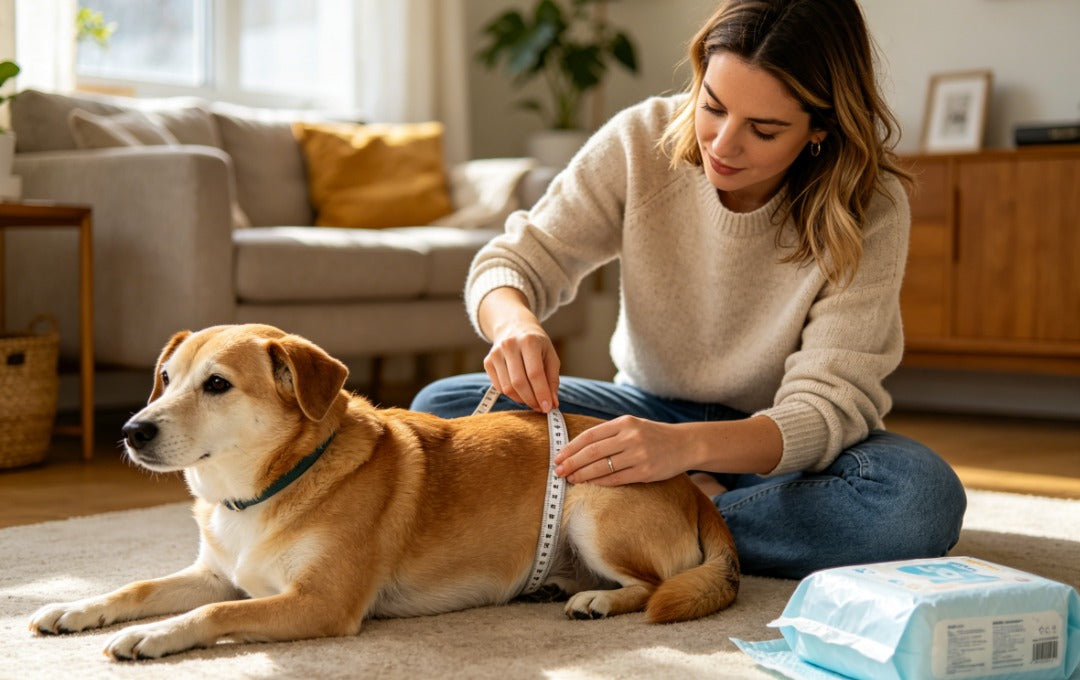
Measure from nose to the base of the tail while your dog is resting. If your dog sleeps stretched out, also measure the space used when lying on their side with legs extended. For a dog that curls into a tight circle, note that resting shape too.
Allow room for your dog to change position without sliding off the bed or pressing against a bolster. A dog that alternates between curling and stretching may need more flat surface than a weight chart suggests. The AKC’s general bed-selection advice also emphasizes matching the bed to a dog’s size and sleeping preferences (American Kennel Club, n.d.).
Confirm what the listed dimensions mean
A bed’s exterior length and width can be larger than the area your dog can actually lie on. Bolsters, raised edges, and thick side panels take up space. When a listing does not clearly distinguish outside dimensions from the sleeping surface, contact the seller or look for a product diagram before ordering.
| Check | What to confirm |
|---|---|
| Exterior dimensions | The full footprint, useful for checking whether the bed fits your room |
| Usable sleeping area | The flat space available after accounting for sides and bolsters |
| Dog’s resting measurements | Length and width in the posture your dog commonly uses |
| Bed shape | Whether the design leaves room to stretch, curl, or rest a head on a bolster |
For large dogs, don’t rely on the word “large” alone. Compare the exact measurements with your dog’s resting posture, and consider how much space the bed will occupy at home. If your dog is growing, reassess the fit as their body size changes.
Compare foam, cover, and construction
A useful comparison starts with what the product page says about the bed’s construction. Does it identify memory foam, conventional foam, fiber fill, or a combination? Are layers described individually? Is thickness published for the selected size? These are verifiable details; a broad claim such as “extra supportive” is harder to compare without supporting specifications.
Do not infer foam density, durability, or joint support from the words “memory foam” or “orthopedic.” If the manufacturer does not disclose testing or material measurements, that uncertainty should remain part of the comparison.
Read care instructions before buying
“Washable dog bed” can mean several different things. It may refer to a removable cover that can be machine-washed, not to the foam insert or entire bed. Check the instructions for each component, including the washing method, drying requirements, and any restrictions.
For a puppy, senior dog, or accident-prone sleeper, a removable cover may make routine cleaning simpler. If moisture protection matters, verify whether the listing describes a water-resistant layer and whether it protects the cover, the insert, or both. Don’t assume that “water-resistant” means waterproof or that the whole bed can go in a washing machine.
Also check the base. A non-slip surface may help keep a bed in place on certain floors, but the listing should explicitly identify that feature. Examine construction details such as seams and zippers if they are shown, and follow the manufacturer’s care instructions to avoid damaging the cover or foam.
Compare care, durability, and value
Price is only one part of value. Compare it with the bed’s size, disclosed materials, care requirements, and purchase protections. Check the price for the exact size and configuration, since options can change the total. Warranty and return terms can also differ by model, seller, and time.
For each bed, confirm the following on the current product or retailer page:
- Exact model name, size, and dimensions
- Materials and construction details
- Cover and insert care instructions
- Current price and any shipping costs
- Warranty duration, coverage, and exclusions
- Return window, condition requirements, and return-shipping terms
- Review source, model, and date checked
Reviews can help reveal recurring concerns about fit, cleaning, or wear, but ratings are not interchangeable across retailers or models. Check that reviews apply to the same bed and size you plan to buy. Treat ratings and prices as time-sensitive information.
A bed may need replacing if its surface remains compressed, the filling shifts or bunches, seams or zippers fail, or the dog can no longer settle comfortably. Inspect the bed periodically, particularly if it is used every day. A worn bed is not automatically the cause of discomfort, but a visibly degraded surface may no longer meet your dog’s needs.
Compare brands without assuming a universal winner
Big Barker, Furhaven, and Bedsure all have dog-bed listings, but the research available for this guide does not establish current prices, ratings, or complete specifications for every model. Their product ranges can include different sizes, styles, and constructions, so compare exact listings rather than brand names alone.
| Brand or option | What to verify on the exact listing |
|---|---|
| Bella & Pal | Current model dimensions, foam composition, cover care, and purchase terms |
| Big Barker | Selected model’s size, construction, dimensions, warranty, and current price |
| Furhaven | Whether the specific sofa-style model uses memory foam or another fill, plus its usable area and care instructions |
| Bedsure | Exact model’s foam type, dimensions, cover construction, care, and current price |
The product-page links supplied for these brands identify places to check current information, but they are not enough to substantiate a complete side-by-side comparison of specifications or terms. Verify details on the listing you intend to buy from. A premium large-dog option, a sofa-style bed, or a lower-priced model may suit different preferences; none is a universal best choice without considering fit, materials, care, and budget.
Make the choice with a short checklist
Before ordering, ask:
- Does the usable sleeping area fit my dog’s usual resting posture?
- Does the listing identify the foam or fill used in this exact model?
- Are thickness, layers, or other construction details published?
- Can the cover be removed, and how must each component be cleaned?
- Are water resistance and base features clearly described?
- Do the current price, warranty, and return terms work for me?
If your dog has persistent joint discomfort, difficulty standing, or a noticeable change in movement, ask a veterinarian for guidance. A bed may make a resting place more comfortable, but it should not replace an assessment of those symptoms (VCA Animal Hospitals, n.d.).
Frequently asked questions
What is a memory foam dog bed?
It is a dog bed whose listing identifies memory foam as part of its cushioning. That label does not necessarily explain the bed’s full construction, thickness, density, or durability. Check the exact model specifications.
What does “orthopedic dog bed” mean?
“Orthopedic” is often used as a style or marketing description for a bed presented as supportive. The term alone does not establish its materials, performance, or ability to treat a health condition.
Do dogs with arthritis benefit from an orthopedic bed?
A comfortable resting surface may be a useful home accommodation, but a bed is not a treatment for arthritis. If your dog shows pain, stiffness, or mobility changes, consult a veterinarian about appropriate care (VCA Animal Hospitals, n.d.).
How do I choose the right dog bed size?
Measure your dog at rest, including a stretched position if they sleep extended. Compare those measurements with the bed’s usable sleeping area, accounting for bolsters and sides. Use weight charts as a starting point, not a substitute for dimensions.
How can I tell if a dog bed is washable?
Read the care instructions for the cover and inner cushion separately. “Washable” may apply only to a removable cover. Confirm whether it can be machine-washed and how it should be dried.
Is a memory foam bed always more supportive than a regular dog bed?
Not necessarily. The label does not disclose all construction details or prove how a particular dog will find the bed. Compare the stated materials and measurements, and consider your dog’s comfort and preferences.
Is Bella & Pal’s memory foam dog bed right for my dog?
That depends on the current model’s dimensions, materials, care requirements, price, and purchase terms. Check those details for the exact size and compare them with your dog’s measurements and household needs.
Compare Bella & Pal bed dimensions, materials, care instructions, and current purchase terms.

發表評論